
AMR for Warehouse Automation
Modern warehouses need faster goods movement, safer internal transport, better task visibility, and lower dependency on manual handling. But many operations still lose productivity because workers walk long distances, pallets wait for movement, replenishment is delayed, and warehouse systems do not always reflect real floor activity.
An AMR for warehouse automation helps solve these problems by moving goods, cartons, totes, pallets, and materials between warehouse zones with less manual effort. Autonomous mobile robots support smoother internal logistics across receiving, storage, picking, packing, staging, replenishment, dispatch, and returns.
With the right AMR strategy, warehouses can reduce repetitive movement, improve throughput, support safer shared-space operations, and create a more connected material flow.
Why Choose AMRs for Warehouse and Logistics Factories?
Autonomous mobile robots are a flexible way to automate warehouse movement without depending only on fixed infrastructure or major layout changes. They can be deployed around existing workflows and scaled as order volume, movement routes, or operational complexity increases.
Reduce worker walking distance
Improve pick-to-pack movement
Move pallets and bulk goods more predictably
Improve replenishment timing
Monitor live robot activity
Reduce aisle congestion
Challenges in Warehouse Operations That AMR Automation Solves
Warehouse operations often appear active, but not every movement creates value. A large amount of time can be lost in walking, waiting, manual transporting, searching, checking, and correcting mistakes.

Workers Walking Long Distances in Warehouse Operations
In many warehouses, workers may walk 15–20 km/day while picking, moving, staging, and fulfilling orders. This can lead to fatigue, injuries, slower work pace, and high turnover. AMRs help reduce non-value-added walking by moving goods between key process points, allowing workers to stay closer to productive work areas.

Manual Picking Errors and Costly Returns
Manual picking errors can lead to mis-picks, wrong shipments, returns, rework, and customer dissatisfaction. When workers are tired, rushed, or constantly moving between zones, error risk increases. A structured AMR-supported goods movement flow helps move picked items more consistently from picking to checking, packing, staging, and dispatch.

Warehouse Throughput Limits During Peak Volume
Manual transport creates a throughput ceiling. When every increase in picks per hour requires more workers or longer shifts, the operation becomes harder to scale.AMRs help create a scalable transport layer that supports higher order movement without relying only on additional headcount.

Rising Labour Cost Per Unit
Every unnecessary walking trip adds cost to the item being moved. As wages rise, manual movement becomes more expensive across daily warehouse operations.Autonomous movement helps reduce repetitive transport labour and improves the use of warehouse teams.

Heavy Pallet Movement and Shared-Aisle Safety Risks
Heavy pallet and bulk transport can create safety risks in shared warehouse aisles. Manual vehicles, pedestrians, pallets, and equipment often operate in the same space, especially during peak replenishment.A heavy pallet transport AMR can support safer, more controlled movement of larger loads across receiving, storage, replenishment, staging, and dispatch zones.

Disconnected WMS, ERP, and Warehouse Execution Systems
When warehouse systems work in silos, inventory records may not match physical stock. This can create write-offs, mis-picks, delayed fulfilment, and poor operational visibility.A connected AMR workflow can help align physical material movement with digital task and inventory records.

No Live View of Warehouse Movement
Warehouse managers need to know what is moving, what is waiting, what is delayed, and what is blocked. Without live visibility, teams often react late to bottlenecks.AMR fleet software can provide a centralized view of robot activity, task status, routes, and battery condition.
How Do Autonomous Warehouse Robots Help Warehouse Operations?
Autonomous warehouse robots help by taking over repeatable transport tasks and creating a more predictable material flow. They move goods between warehouse zones while reducing unnecessary walking, waiting, and manual vehicle dependency.
Autonomous Goods Movement for Pick-to-Pack Flow
Autonomous goods movement helps move totes, cartons, picked goods, small loads, and warehouse materials between picking zones, packing stations, staging areas, and dispatch lanes.
This improves flow by reducing the time workers spend transporting items manually.
Heavy Pallet Transport AMR for Bulk Movement
Heavy-duty AMRs support movement of pallets, bulk goods, replenishment loads, and larger materials. This is useful when warehouses face aisle congestion, operator shortages, or inconsistent replenishment timing.
By automating repetitive pallet routes, warehouses can improve safety, reduce traffic pressure, and create more predictable bulk movement.
Real-Time Task Dispatch for Faster Fulfilment
When AMRs are connected to warehouse systems, movement tasks can be created and assigned faster. This reduces the lag between order activity and the start of fulfilment movement.
Real-time task dispatch helps warehouses move from manual instruction to connected, system-driven transport.
WMS ERP Integration for Connected Warehouse Movement
WMS ERP integration connects robot movement with order flow, inventory activity, replenishment requirements, and fulfilment operations.
This improves alignment between what the system shows and what is physically moving inside the warehouse.
AMR Fleet Orchestration for Multi-Zone Warehouses
As robot usage grows, AMR fleet orchestration becomes important. It helps coordinate multiple robots across warehouse zones, reduce traffic conflicts, centralize task visibility, and manage movement from one software layer.
Fleet orchestration is especially useful for larger warehouses, multi-zone facilities, and operations planning long-term automation growth.
How Do Autonomous Warehouse Robots Help Warehouse Operations?
Autonomous warehouse robots help by taking over repeatable transport tasks and creating a more predictable material flow. They move goods between warehouse zones while reducing unnecessary walking, waiting, and manual vehicle dependency.
Distribution Centres
Distribution centres need fast movement between receiving, storage, picking, staging, and dispatch. AMRs support smoother goods flow across large warehouse areas.
Fulfilment Centres
Fulfilment centres handle frequent order movement, packing flow, returns, and dispatch deadlines. AMRs can support pick-to-pack movement, replenishment, and reverse logistics.
Third-Party Logistics Warehouses
Third-party logistics warehouses manage multiple customers, SKUs, workflows, and service requirements. AMRs help improve movement flexibility and reduce manual transport dependency.
E-Commerce Warehouses
E-commerce warehouses face order spikes, high picking pressure, fast shipping expectations, and frequent returns. AMRs help improve internal movement without relying only on temporary labour.
Cold Storage Warehouses
Cold storage warehouses need efficient movement to reduce worker exposure and improve process consistency in temperature-controlled environments.
Manufacturing Warehouses
Manufacturing warehouses need predictable movement of components, work-in-progress, finished goods, pallets, and replenishment materials between storage, production, and dispatch areas.
Types of Warehouses Operations We Support with AMR Automation
AMRs can support different warehouse environments where repetitive movement, high labour effort, and fulfilment speed are major operational concerns.

Distribution Centres
Distribution centres need fast movement between receiving, storage, picking, staging, and dispatch. AMRs support smoother goods flow across large warehouse areas.
Fulfilment Centres
Fulfilment centres handle frequent order movement, packing flow, returns, and dispatch deadlines. AMRs can support pick-to-pack movement, replenishment, and reverse logistics.
Third-Party Logistics Warehouses
Third-party logistics warehouses manage multiple customers, SKUs, workflows, and service requirements. AMRs help improve movement flexibility and reduce manual transport dependency.
E-Commerce Warehouses
E-commerce warehouses face order spikes, high picking pressure, fast shipping expectations, and frequent returns. AMRs help improve internal movement without relying only on temporary labour.
Cold Storage Warehouses
Cold storage warehouses need efficient movement to reduce worker exposure and improve process consistency in temperature-controlled environments.
Manufacturing Warehouses
Manufacturing warehouses need predictable movement of components, work-in-progress, finished goods, pallets, and replenishment materials between storage, production, and dispatch areas.
Retail and FMCG Warehouses
High-volume retail and FMCG warehouses need faster replenishment, reliable goods movement, and reduced congestion during peak activity.
Our Autonomous Mobile Robot (AMR) Product Range
Synergy Automatics offers a complete range of Autonomous Mobile Robot (AMR) solutions for material handling, warehouse automation, and factory logistics. Our AMRs are customized based on payload capacity, factory layout, navigation, and application requirements to improve productivity, safety, and operational efficiency.
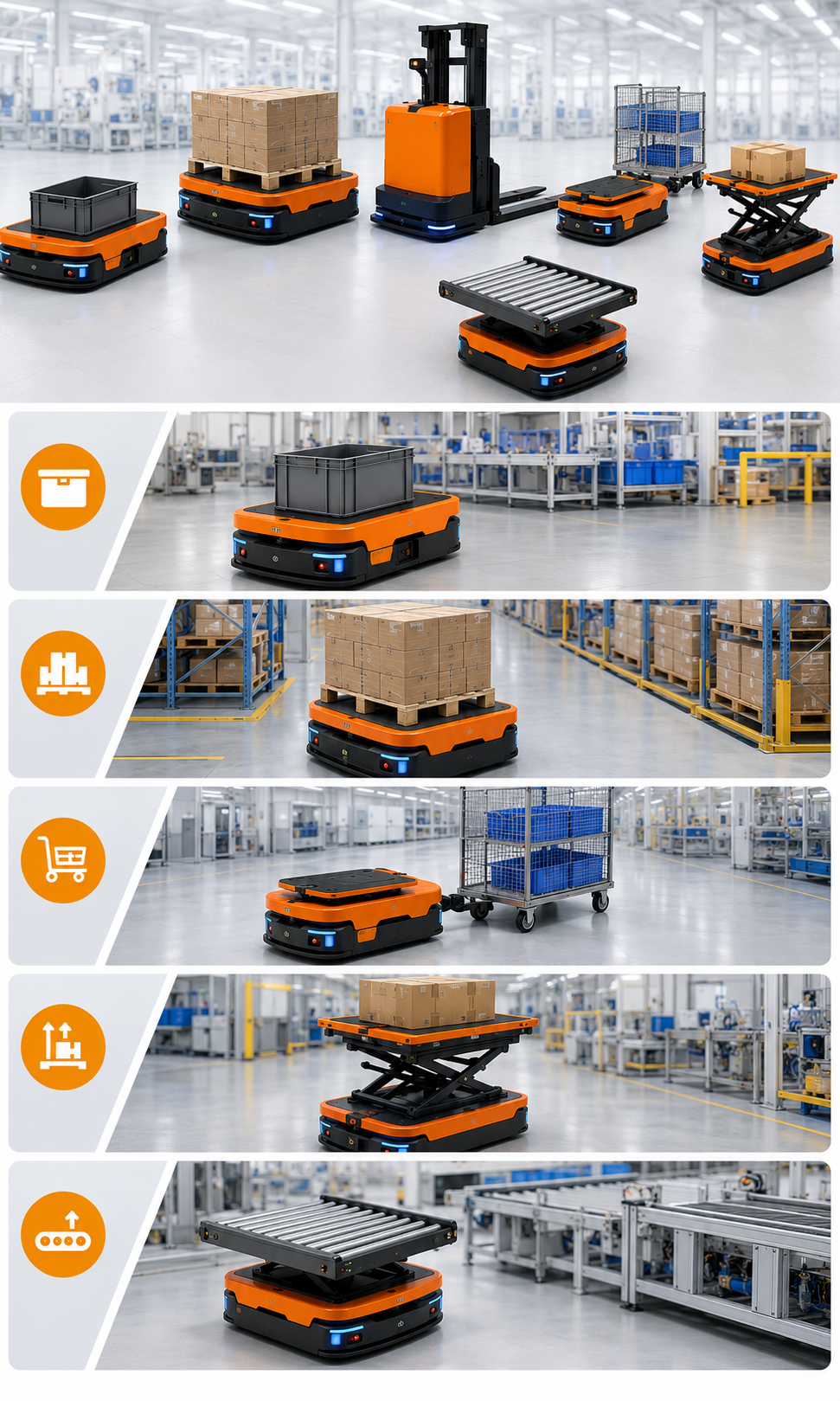
Compact Platform AMR
The Compact Platform AMR is designed to transport bins, boxes, trays, and small components across production lines and warehouses. It is ideal for line feeding, work-in-progress (WIP) movement, and conveyor integration, ensuring fast and efficient material handling in compact spaces.
Heavy Platform AMR
The Heavy Platform AMR is built for moving pallets, heavy materials, and finished goods in manufacturing facilities and warehouses. It offers high payload capacity, safe transportation, and reliable performance for industrial material handling applications.
Towing AMR
The Towing AMR automates the movement of trolleys, carts, and material carriers across factories and warehouses. It is ideal for long-distance internal transport, line-side delivery, and warehouse-to-production material movement.
Lifting AMR
The Lifting AMR automatically lifts and transports pallets, racks, carts, and custom load carriers. It simplifies pallet pickup, loading, unloading, and warehouse automation while improving safety and reducing manual handling.
Conveyor AMR
The Conveyor AMR enables automatic material transfer between conveyors, machines, packing lines, and workstations. It ensures continuous material flow, improves production efficiency, and supports seamless factory automation.
Why Choose Synergy Robotixs AMR Automation for Warehouse Intralogistics?
Workflow-First Warehouse Automation Planning: We analyze warehouse workflows first to identify repetitive tasks, inefficiencies, and the best opportunities for automation.
Integration-Ready AMR System Design: Our AMRs are designed to integrate smoothly with WMS, ERP, conveyors, lifts, doors, and other warehouse systems.
Measurable Warehouse Automation Outcomes: Our AMR solutions deliver tangible benefits including improved productivity, reduced manual effort, faster material flow, and increased throughput.
Application-Based AMR Deployment: Our AMR solutions are customized for specific warehouse applications such as material movement, pallet transport, and fleet management.
Scalable Warehouse AMR Automation: Start with a single automation process and seamlessly expand across multiple workflows as your operations grow.
Safety-Focused AMR Deployment: We prioritize safe robot operation through intelligent navigation, obstacle detection, traffic management, and route planning.
FAQ About AMR for Warehouse & Logistics Automation
1. How do autonomous warehouse robots reduce worker walking?
Autonomous warehouse robots take over repetitive point-to-point movement tasks, allowing workers to stay closer to picking, packing, checking, replenishment, and exception-handling areas.
2. Which warehouse tasks can AMRs automate?
AMRs can automate goods movement, pallet transport, pick-to-pack transfer, receiving-to-staging movement, replenishment support, packing-to-dispatch movement, returns movement, and system-connected task dispatch.
3. Can AMRs help reduce picking errors?
AMRs can help create a more structured movement flow between picking, checking, packing, staging, and dispatch. This reduces the operational conditions that often lead to mis-picks and returns.
4. Can AMRs move heavy pallets?
Yes. Heavy-duty AMRs can support pallet movement, bulk transport, replenishment, staging, and heavier internal logistics workflows.
5. Can AMRs connect with WMS and ERP systems?
Yes. AMRs can connect with warehouse and enterprise systems so movement tasks can align with orders, inventory activity, replenishment needs, and fulfilment flow.
6. What is AMR fleet orchestration?
AMR fleet orchestration is the coordination of multiple robot workflows through a centralized software layer. It helps improve fleet visibility, task control, route planning, and traffic management.
7. Are AMRs safe for shared warehouse spaces?
AMRs can be designed with sensing, obstacle detection, route planning, slowdown zones, and stop zones to support safe movement around people, racks, pallets, and equipment.
8. Which warehouse types can use AMRs?
AMRs can be used in distribution centres, fulfilment centres, third-party logistics warehouses, e-commerce warehouses, cold storage facilities, manufacturing warehouses, and high-volume retail or FMCG warehouses.
9. How do I know which AMR application is right for my warehouse?
The right application depends on movement routes, load type, walking distance, pallet flow, software systems, bottlenecks, and throughput goals. A warehouse automation assessment can identify the best starting point.