
Automated Guided Vehicle for Manufacturing Industry
Manufacturing productivity depends on one simple thing: materials must reach the right place at the right time. Raw materials need to move from storage to production lines, components must reach assembly stations, work-in-progress must flow between operations, and finished goods must move safely to packaging, storage, or dispatch.
When internal transport depends only on manual movement, facilities may face delayed medication delivery, contamination and human error during sample movement, higher labor requirements, reduced traceability of medical supplies, and delays in critical healthcare services. Synergy Robotix provides AGV solutions that intelligently navigate between predefined pickup and delivery locations to automate internal material transport, helping healthcare and pharmaceutical facilities improve efficiency while reducing manual handling and operational risks.
Our automation solutions support hospitals, diagnostic centers, pharmacies, cleanrooms, and pharmaceutical production facilities with safer, more structured, and highly reliable internal logistics.
Why AGVs Matter in Manufacturing Plants
An AGV for Manufacturing Industry creates a more disciplined material movement system by connecting stores, production areas, assembly lines, inspection points, and warehouse zones through automated transport.
Improves coordination between stores and production departments
Helps prevent machine waiting time caused by material delays
Keeps material movement consistent during production hours
Reduces dependence on forklifts for repeated movement
Supports safer movement in shared industrial spaces
Reduces unnecessary worker travel across the shop floor
Supports future expansion of factory automation
Helps standardize internal logistics processes
Features of Our Manufacturing AGV Solutions
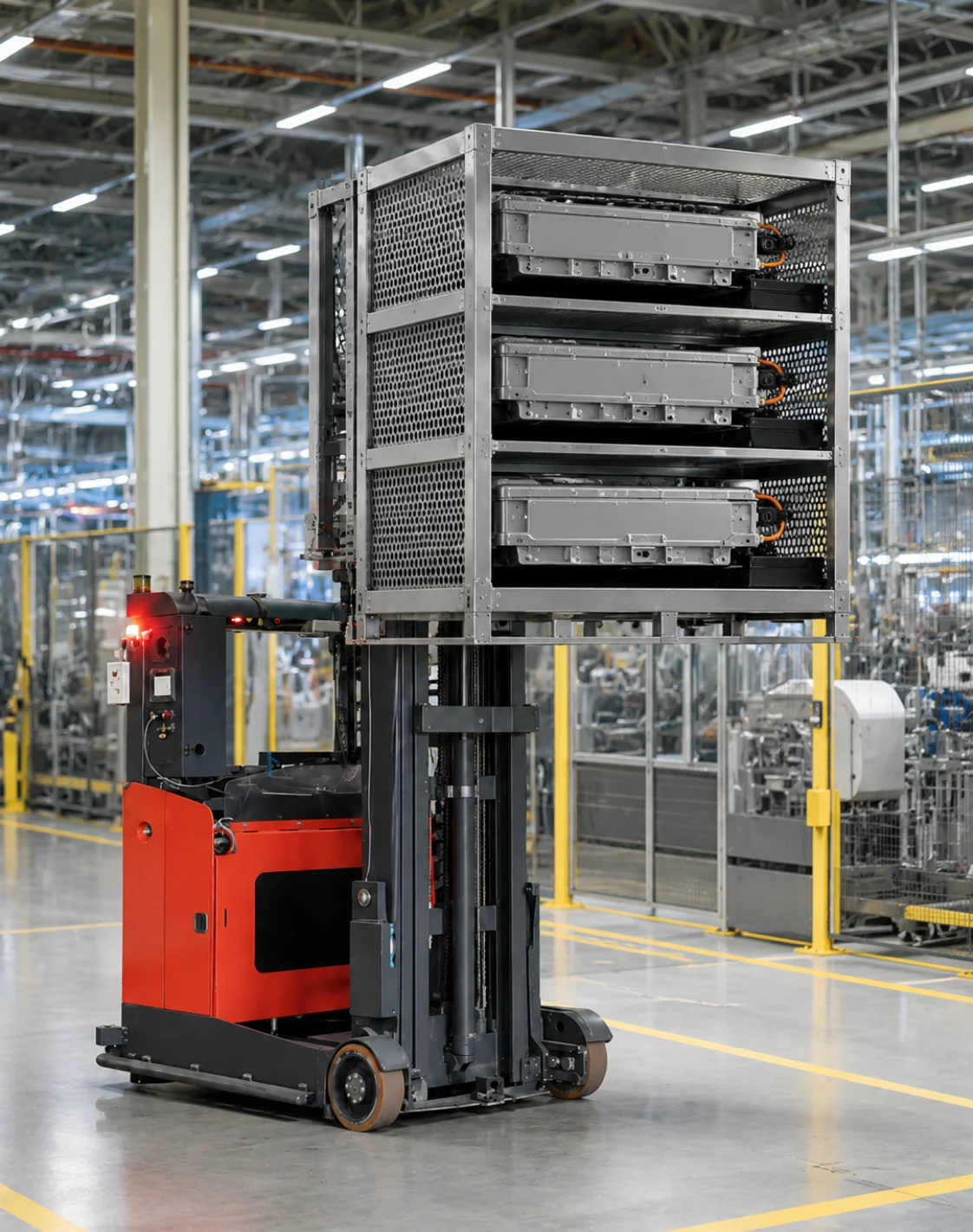

Customizable design based on material size, load weight, route length, transfer method, and floor condition.
Navigation options such as LiDAR, laser, SLAM, QR code, magnetic guidance, or vision-based movement.
Safety systems such as scanners, obstacle detection, emergency stop, alarms, and controlled speed zones.
Integration with MES, ERP, WMS, PLCs, conveyors, lifts, doors, and production equipment
Transport support for pallets, bins, racks, trolleys, tools, WIP materials, and finished goods.
Fleet coordination for facilities using multiple AGVs across different routes.
Scalable deployment from one movement route to wider plant-level automation.
Task-based movement between defined pickup and drop-off points.
Benefits of AGV Automation in Manufacturing Unit
A properly planned AGV system can improve both productivity and safety inside a manufacturing plant. Key benefits include:
Better coordination between warehouse and production teams
Lower congestion in production and warehouse areas
Faster and more consistent material delivery
More efficient use of workers and operators
Improved visibility of internal logistics
Improved production line availability
Better support for JIT manufacturing
Reduced manual material handling
Safer movement of heavy loads
Lower forklift dependency
Reduced product damage
Applications of Automated Guided Vehicles for Factories
Automated Guided Vehicles for Factories can be used across multiple zones inside a manufacturing facility. The best applications are usually repetitive, predictable, and high-frequency movement tasks.
AGV Logistics for Manufacturing in Warehouse-to-Line Flow
AGV Robot for Manufacturing Heavy Component Movement
AGV Automation for Manufacturing in Assembly Line Supply
Smart AGV for Manufacturing Facilities in WIP Movement
AGV Transportation System for Manufacturing in JIT Delivery
AGV in Manufacturing Industry for Raw Material Transport
Factory AGV Systems for Finished Goods Transport
Manufacturing Plant AGV for Pallet Handling
Why Choose Synergy Robotix?
Choosing the right AGV partner is important for building a safe, reliable, and scalable material handling system. Synergy Robotix provides AGV robotics solutions designed around real manufacturing challenges, not generic automation models.
Manufacturing-Focused Expertise
We design AGV solutions for raw material movement, assembly line feeding, WIP transfer, pallet handling, finished goods transport, warehouse integration, and heavy component movement.
Smart System Integration
Our AGV systems can be planned for integration with conveyors, production equipment, warehouse systems, fleet control, charging stations, and factory management software.
Scalable Automation Approach
Whether you need a single AGV or a complete fleet, Synergy Robotix helps you build a solution that can grow with your production requirements.
Safety-First Planning
We consider traffic zones, route width, turning radius, floor condition, load stability, and safety requirements before implementation.
End-to-End Project Support
Our team supports application study, AGV selection, layout planning, route design, installation, commissioning, and long-term service.
Customized AGV Solutions
We recommend AGV systems based on your load type, movement frequency, route layout, and production needs.
FAQ for AGV Robotics Solutions
1. Why do manufacturing companies use AGV systems?
Manufacturing companies use AGV systems to automate repetitive transport tasks such as raw material delivery, assembly line feeding, WIP movement, pallet handling, and finished goods transfer. This helps reduce forklift dependency, improve production flow, and lower delays caused by manual handling.
2. How does an Automated Guided Vehicle for Manufacturing work?
An Automated Guided Vehicle for Manufacturing receives a transport command, moves to the pickup point, collects the load, follows a planned route, and delivers the material to the required destination. It can be used between warehouse, production, assembly, inspection, packaging, and dispatch areas.
3. Which industries can use AGV robotics solutions?
AGV robotics solutions are suitable for automotive, engineering, electronics, FMCG, pharmaceuticals, packaging, logistics, warehousing, heavy machinery, and general manufacturing industries. They are especially useful where material movement is repetitive, frequent, heavy, or time-sensitive.
4. Can AGVs reduce forklift usage in factories?
Yes. A Manufacturing AGV can reduce repetitive forklift trips by automating fixed material movement routes. AGVs are commonly used for pallet transport, raw material supply, warehouse-to-line movement, finished goods handling, and just-in-time delivery.
5. Are AGVs safe to use around workers?
Yes. Modern Factory AGV Systems are designed with safety features such as sensors, obstacle detection, warning lights, speed control, emergency stop functions, and controlled route planning. Proper safety planning helps AGVs operate safely around workers, machines, forklifts, and production areas.
6. What type of materials can an AGV move?
An Industrial AGV for Manufacturing can move pallets, bins, racks, trolleys, carts, trays, containers, fixtures, semi-finished goods, finished products, and heavy components. The right AGV type depends on the load size, weight, shape, pickup method, and movement route.
7. Which AGV is best for assembly line feeding?
For assembly line feeding, a tugger AGV or lift-top AGV is commonly used. These AGVs can transport carts, kits, bins, racks, and trolleys to production stations. AGV Automation for Manufacturing helps ensure that operators receive the right materials at the right time.
8. Can AGVs help with WIP movement?
Yes. A Smart AGV for Manufacturing Facilities can move work-in-progress between machines, production cells, inspection areas, buffer zones, and assembly stations. This helps reduce waiting time between operations and improves production continuity.
9. What is AGV material handling in manufacturing?
AGV Material Handling in Manufacturing means using automated guided vehicles to move materials inside a manufacturing plant. This includes raw material transport, component supply, WIP transfer, pallet handling, finished goods movement, and warehouse-to-production flow.
10. Can AGVs be used for pallet handling?
Yes. A Manufacturing Plant AGV can be used for pallet handling between receiving, storage, production, packaging, and dispatch areas. Fork AGVs are commonly used for lifting and transporting palletized raw materials, WIP pallets, and finished goods pallets.
11. Do AGVs support just-in-time material delivery?
Yes. An AGV Transportation System for Manufacturing can support just-in-time material delivery by moving parts and materials to the production line only when needed. This helps reduce excess line-side inventory and prevents production stoppages caused by material shortages.
12. Can AGVs connect warehouse and production areas?
Yes. AGV Logistics for Manufacturing can connect warehouse storage, production lines, conveyors, inspection zones, packaging areas, and dispatch points. This improves coordination between departments and provides better visibility of material movement.
13. How do I know which AGV is right for my factory?
The right AGV depends on your load type, load weight, travel distance, route complexity, movement frequency, floor condition, safety needs, and integration requirements. Synergy Robotix studies your factory operation before recommending the most suitable AGV Solutions for Manufacturing Plants.