
AGV for Automotive Assembly Line Feeding
Automotive assembly lines depend on continuous and accurate material supply. Every workstation needs the right parts, kits, bins, racks, trolleys, tools, and subassemblies at the right time. If materials do not reach the line on time, the result can be material shortages, operator waiting time, assembly interruptions, reduced line efficiency, and higher production costs.
An AGV for Automotive Assembly Line Feeding helps automate repeated material movement between warehouses, supermarkets, kitting areas, staging zones, and assembly workstations. Based on task instructions from the production line or control system, the AGV moves along predefined or dynamically planned routes, picks up materials from the assigned location, and delivers them to the required workstation with controlled pickup and drop-off movement. Instead of depending only on forklifts, manual trolleys, or workers, Automated Guided Vehicles keep materials moving in a structured and timely flow across the assembly area.
Synergy Robotix provides customized AGV solutions for automotive assembly line feeding, parts delivery, kit movement, rack transport, trolley movement, subassembly transfer, warehouse-to-line supply, and empty-bin return.
Why Choose an Automotive AGV for Production Flow?
Automotive assembly operations work on strict production timing. A delayed parts kit, missing rack, wrong component, or unavailable trolley can disturb the full assembly flow. When material feeding depends only on manual movement, the process may become inconsistent, slow, and difficult to control.
Reducing forklift movement near assembly stations
Moving subassemblies between production cells
Moving bins, racks, containers, and trolleys
Supplying parts to assembly workstations
Returning empty bins, racks, and trolleys
Supporting supermarket-to-line supply
Delivering kits to line-side stations
Transporting tools and fixtures
Features of Our Automative AGV Solutions
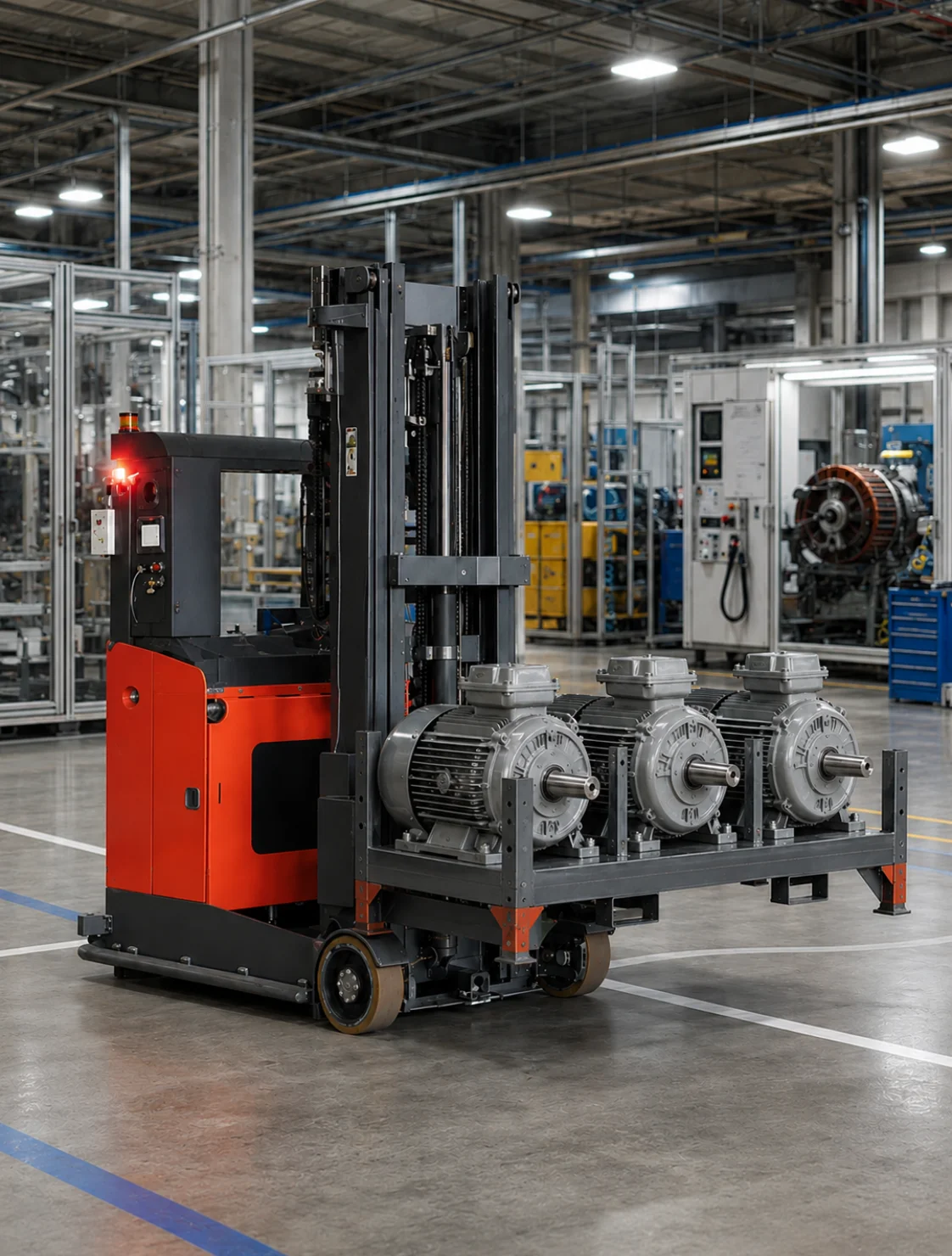

Workflow support for component supply, kitting delivery, line feeding, empty container return, warehouse-to-line movement, and sub-assembly transfer.
Safety scanners, obstacle detection, emergency stop systems, warning indicators, speed control, and collision avoidance.
Integration with MES, ERP, WMS, PLCs, production planning systems, conveyors, doors, lifts, and Industrial IoT platforms.
Scalable fleet options for single-line feeding, multi-line production, or full factory material flow automation.
Automated movement of components, kits, pallets, racks, totes, containers, and production materials.
Configurable vehicle design based on payload, route distance, facility layout, assembly sequence, and production workflow.
Smart fleet control for task assignment, route planning, vehicle coordination, and traffic management.
Accurate delivery to defined assembly stations, kitting areas, supermarkets, and production points.
Intelligent navigation using LiDAR, laser, SLAM, QR code, magnetic, or vision guidance.
Automatic charging support for long production shifts and reduced downtime.
Benefits of AGV for Automotive Assembly Line Feeding
Lower Production Costs
By reducing manual dependency, movement delays, material shortages, and accident risks, AGVs help improve cost control in automotive assembly operations.
Reduced Material Shortages
AGVs help deliver parts, kits, racks, and bins to workstations before shortages occur. This improves line-side material availability and reduces production delays.
Improved Material Movement Visibility
When connected with fleet management systems, MES, WMS, or ERP, AGVs help track task status, delivery timing, and material movement.
Improved Workplace Safety
AGVs reduce unnecessary forklift traffic and manual movement near assembly stations, helping create a safer production environment.
Better Support for Lean and Just-in-Time Manufacturing
AGVs can deliver parts based on production demand, helping reduce excess line-side inventory while keeping workstations supplied.
Improved Assembly Line Efficiency
Automated material movement allows operators to focus on assembly tasks instead of waiting for parts or moving materials manually.
Fewer Assembly Line Interruptions
By improving delivery timing, AGVs reduce interruptions caused by missing materials, delayed kits, or unavailable components.
Better Line-Side Organization
AGVs support planned material delivery and empty-bin return, helping reduce clutter near workstations.
Reduced Worker Fatigue
AGVs reduce repeated manual handling of parts, bins, racks, trolleys, and heavy components.
Applications of AGV for Automative Assembly Industries
Engine, transmission, battery, dashboard, seat, tire, bumper, and door component transport
Internal logistics support for model changeovers and production expansion
Finished component transfer to inspection or quality control areas
Support for EV battery and electric vehicle assembly workflows
Component transportation from warehouse to assembly areas
Sub-assembly transfer between production departments
Wiring harness and electronic module movement
Material movement for OEM and Tier supplier operations
Warehouse-to-line feeding for scheduled production
Empty pallet, tote, rack, and container return
Kitted parts delivery to production stations
Supermarket-to-line material movement
Why Choose Synergy Robotix?
Choosing the right AGV partner is important for building a safe, reliable, and scalable material handling system. Synergy Robotix provides AGV robotics solutions designed around real manufacturing challenges, not generic automation models.
Assembly Line Feeding Expertise
We support parts delivery, kit movement, rack transport, trolley movement, and warehouse-to-line supply.
End-to-End Support
Our team supports AGV selection, route planning, installation, commissioning, and service support.
Reduced Manual Dependency
AGV automation helps reduce forklift use, manual trolley movement, and repeated operator handling.
Scalable Automation Approach
AGVs are designed based on your load type, route, workstation layout, and assembly line requirement.
Customized AGV Design
AGVs are designed based on your load type, route, workstation layout, and assembly line requirement.
Safety-Focused Planning
We plan AGV routes with pedestrian zones, speed control, sensors, and emergency stop systems.
Plant System Integration
AGVs can integrate with MES, WMS, ERP, call systems, conveyors, and production schedules.
Better Material Flow
Our AGVs help deliver the right parts to the right workstation at the right time.
FAQ AGV for Automotive Assembly Line Feeding
1. Why are AGVs important for automotive assembly lines?
AGVs are important because they reduce material shortages, improve parts delivery timing, reduce worker fatigue, lower forklift dependency, and help prevent assembly line interruptions.
2. How does an automated guided vehicle reduce assembly line stoppages?
An automated guided vehicle reduces assembly line stoppages by delivering required materials to the right workstation before operators run out of parts.
3. Can AGVs supply parts to multiple assembly workstations?
Yes, assembly line AGVs can deliver different parts, kits, bins, or racks to multiple workstations based on planned routes or production demand.
4. Which AGV is best for automotive line feeding?
A Tugger AGV for automotive line feeding is commonly used because it can pull multiple carts, racks, bins, or trolleys in one trip.
5. Can automotive AGVs move heavy parts and subassemblies?
Yes, automotive material handling AGVs can be designed to move heavy parts, subassemblies, racks, and components based on load weight and plant layout.
6. Can AGVs deliver kits to automotive assembly stations?
Yes, an AGV for kit delivery can move pre-arranged kits to assembly stations for sequenced production and just-in-time material supply.
7. Can AGVs return empty bins, racks, and trolleys?
Yes, an AGV for empty bin return can move empty bins, racks, trolleys, containers, and returnable packaging back to the supermarket or storage area.
8. Do AGVs reduce forklift movement near assembly lines?
Yes, AGV automation in automotive assembly reduces forklift use on repeated supply routes and helps make line-side areas safer and more organized.
9. Can assembly line AGVs integrate with MES, WMS, or ERP?
Yes, automotive assembly AGV systems can integrate with MES, WMS, ERP, fleet management software, call systems, conveyors, and production schedules.
10. Are AGVs safe to use near assembly line workers?
Yes, industrial AGVs for automotive plants are planned with safety sensors, speed control, warning signals, emergency stops, and defined routes.
11. How do I choose the right AGV for assembly line material flow?
The right AGV for assembly line material flow depends on load type, route distance, workstation layout, delivery frequency, floor condition, and system integration needs.
12. Can AGVs be customized for our automotive plant layout?
Yes, custom AGVs for automotive assembly lines can be designed based on load size, pickup method, route design, workstation height, and plant layout.