
Industrial robotics
AMR with Robotic Arm
Select and integrate the robotic architecture around the process, payload, workspace, mobility, tooling, safety controls and required evidence.
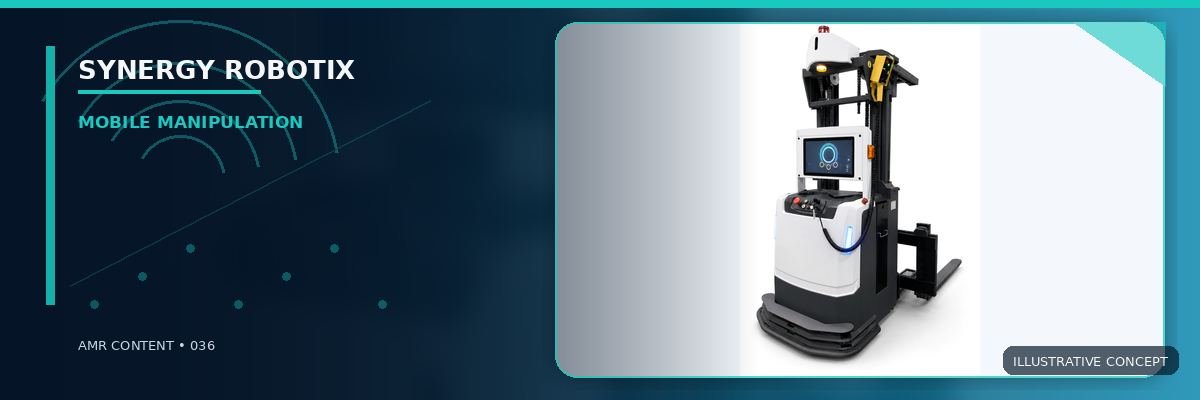
Start AMR with Robotic Arm with the process and workspace
Reliable use of AMR with Robotic Arm depends on how well the vehicle, load or payload, route, interfaces and operating team work together. The equipment name alone does not define the final application.
Process outcome
State the operation that AMR with Robotic Arm must complete, including part presentation, cycle sequence, quality evidence and manual fallback.
Robot and tooling fit
Evaluate payload, reach, pose, workspace, mobility, end effector, cables, utilities and the effect of tooling on the usable envelope.
Cell or fleet integration
Coordinate machines, fixtures, vision, safety controls, task software and recovery so the complete process—not just the robot motion—can be accepted.
Engineering inputs that shape AMR with Robotic Arm
Build the requirement for the AMR with Robotic Arm from representative operating data. Capture origins, destinations, loaded and empty travel, task frequency, peak demand, waiting, priority work, charging opportunities and the manual fallback. Average demand alone can hide the short periods that determine vehicle count or service level.
Survey manufacturing and industrial facilities using the intended load or payload. Record load dimensions, mass, centre of gravity, carrier condition, orientation and transfer method, route width, turns, surfaces, gradients, crossings, doors, lifts, transfer geometry, lighting, contamination and wireless coverage. Measurements should include the least forgiving parts of the process, not only the easiest demonstration route.
Evidence to prepare before equipment selection
- Origins, destinations and task demand by period
- Representative load, carrier or payload evidence
- Measured route and transfer-point geometry
- Traffic, people and shared-resource conditions
- System interfaces and ownership
- Normal, peak, exception and recovery criteria
How AMR with Robotic Arm moves from request to completion
For AMR with Robotic Arm, the operating sequence should make task ownership, physical handling, system states and recovery visible from release through completion.
-
Authorise the process
Production control confirms the part, task, tooling state, machine availability and required quality evidence.
-
Acquire and verify
Vision, sensors or fixtures establish part identity, pose and acceptable presentation before motion or handling.
-
Execute coordinated motion
The robot, mobile base or surrounding equipment performs the sequence inside the approved workspace and safety concept.
-
Confirm process outcome
The system records placement, machine state, inspection result or completed transport before releasing downstream work.
-
Recover from exceptions
Mis-picks, unavailable machines, tooling faults, localisation loss and interrupted cycles use controlled recovery procedures.
Connect AMR with Robotic Arm to equipment and information flow
Interfaces around AMR with Robotic Arm should be stateful, testable and owned. A clear handshake is easier to operate and support than a collection of one-way commands.
Production control
Coordinate AMR with Robotic Arm with machine states, schedules, part identity, quality records and downstream readiness.
Tooling and vision
Manage tool identification, utility connection, calibration, part pose, inspection and failed-acquisition recovery.
Mobile or cell control
Define how robot motion, vehicle motion, fixtures and safety controls share authority and confirm the process state.
Operations and maintenance
Provide actionable alarms, logs, controlled modes and service access without bypassing the approved safety concept.
Design safe operation and practical recovery for AMR with Robotic Arm
Safety for AMR with Robotic Arm should be designed around the complete operating environment. Consider people, manual vehicles, blind corners, crossings, doors, transfer zones, unstable or damaged loads, maintenance access and foreseeable recovery actions.
Vehicle sensing is only one layer. Speed and route rules, layout, separation, visibility, workstation design, access management, training, procedures and emergency arrangements may also be required. Competent project stakeholders must select and validate the measures for the installed application.
Subjects to include in the installed review
- Operating modes and authorised users
- Shared-space traffic and crossings
- Load and transfer-point hazards
- Protective functions and site controls
- Maintenance and manual recovery
- Emergency stop and controlled restart
Evidence to review before approving AMR with Robotic Arm
For AMR with Robotic Arm, convert assumptions into records that can be reviewed, tested and maintained through the project lifecycle.
| Decision area | Evidence to prepare | How to validate it |
|---|---|---|
| Workflow | Origins, destinations, demand, queues, priority and fallback | Run normal and peak mission patterns |
| Load or payload | Load dimensions, mass, centre of gravity, carrier condition, orientation and transfer method | Use representative carriers and worst credible conditions |
| Route and environment | Manufacturing and industrial facilities, including constraints and shared traffic | Test the least-forgiving sections |
| Interfaces | Wms, wcs, erp or mes tasks, scanners, conveyors, doors, lifts, call stations, production controls and charging points | Challenge acknowledgement, timeout and recovery |
| Operations | Charging, maintenance, training, support and change control | Rehearse intervention and controlled restart |
Measure the operating outcome for AMR with Robotic Arm
For AMR with Robotic Arm, useful performance measures connect mobile activity with the workflow result and the effort needed to sustain it.
Flow reliability
Track whether AMR with Robotic Arm completes the intended missions with stable handoffs, visible queues and controlled exception handling.
Operational effort
For AMR with Robotic Arm, measure walking, driving, waiting, manual intervention, supervision and recovery work before and after implementation.
System availability
Review completed tasks, downtime causes, charger or resource queues, maintenance and return-to-service time for AMR with Robotic Arm.
A staged route from concept to acceptance for AMR with Robotic Arm
A controlled AMR with Robotic Arm project should move through decision gates rather than treating installation as one event. Each stage should confirm that assumptions about the task, load or payload, site, interfaces, safety responsibilities and operating model still match the evidence.
Acceptance should use representative loads, routes, traffic and interfaces. Include blocked paths, unavailable destinations, failed handshakes, low energy, emergency stops, manual recovery and controlled restart, then hand over clear roles and maintenance routines.
-
Discover
Map the workflow or mission, stakeholders, current constraints and measurable outcome.
-
Survey
Capture representative loads or payloads, route or terrain, transfer points, services, traffic and hazards.
-
Engineer
Select the architecture, define interfaces, controls, safety measures, energy and support responsibilities.
-
Implement
Configure, integrate and test components with controlled change and traceable issue resolution.
-
Accept
Run representative normal, peak, fault and recovery tests before training and operational handover.
Related robots, applications and guides
Use these Synergy Robotix resources to compare adjacent product, application, integration and selection decisions connected with AMR with Robotic Arm.
FAQ
Questions buyers ask
Straight answers about AMR with Robotic Arm.
Still have a question? Our engineers answer every enquiry personally.
What information is needed to assess AMR with Robotic Arm?
Prepare the workflow or mission, task demand, route or operating area, load dimensions, mass, centre of gravity, carrier condition, orientation and transfer method, transfer method, interfaces, operating hours, traffic and known hazards.
How is the number or size of mobile robots determined?
Use loaded and empty travel, pickup and delivery time, waiting, charging, congestion, availability and the required service level. Peak demand and exceptions matter as well as averages.
Can mobile robots operate around people and manual vehicles?
Mixed operation may be possible when the installed risk assessment, protective functions, layout, traffic rules, training and emergency arrangements support it.
How does the system connect to warehouse or production controls?
Interfaces may exchange task, load, source, destination, priority, readiness and completion states through WMS, WCS, ERP or MES tasks, scanners, conveyors, doors, lifts, call stations, production controls and charging points. Define timeouts, alarms and recovery ownership.
What should be validated before handover?
Test representative missions, loads, routes, traffic, transfers, charging and interfaces, including blocked paths, failed signals, low energy, emergency stops and controlled restart.
Let us engineer the right fit
Plan AMR with Robotic Arm around the real operation
Share the load or payload, route or operating domain, task demand, transfer points, interfaces and known constraints for AMR with Robotic Arm. Send them to us and a Synergy Robotix engineer will come back with the questions that matter and a practical next step.