
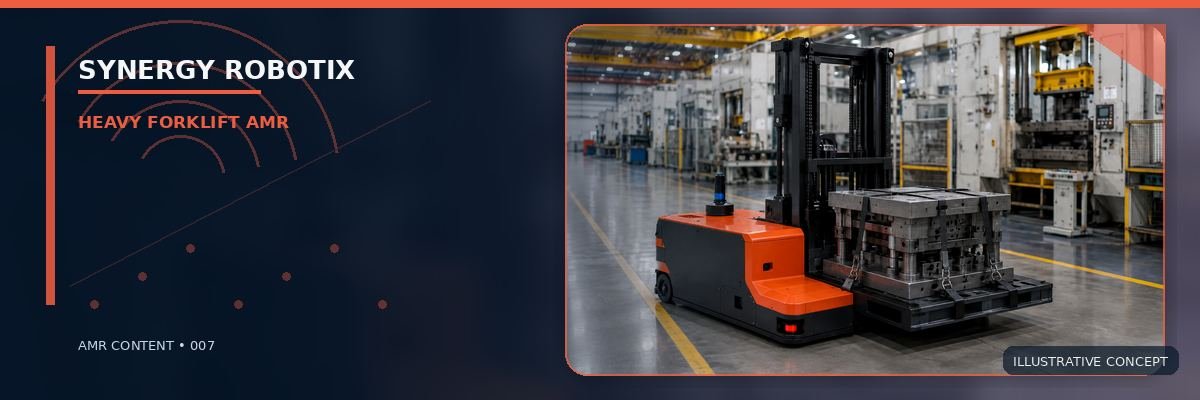
Autonomous pallet handling
Heavy Forklift AMR for Multi-Tonne Handling and High-Bay Stacking
Engineer autonomous load handling around the carrier, centre of gravity, route, transfer geometry, traffic conditions and approved operating envelope.
Match Heavy Forklift AMR for Multi-Tonne Handling and High-Bay Stacking to the real load and route
Operations teams evaluating Heavy Forklift AMR for Multi-Tonne Handling and High-Bay Stacking should connect commercial goals with site evidence. Demand, carrier condition, route geometry, control ownership, safety measures and acceptance criteria all influence the configuration and deployment plan.
For Heavy Forklift AMR for Multi-Tonne Handling and High-Bay Stacking, operations, engineering, safety, controls or IT, maintenance and procurement should use one shared requirement set so technical and commercial decisions remain aligned.
Load acquisition
Define pallet condition, fork-pocket geometry, mass, dimensions, load centre, stability and approach direction and the tolerance at pickup. Reliable travel cannot compensate for an unstable or incorrectly presented load. Include this subject in the staging review for Heavy Forklift AMR for Multi-Tonne Handling and High-Bay Stacking.
Route and manoeuvring
Measure aisle width, turning sweep, floor condition, gradients, crossings and waiting positions with the intended carrier and load represented. Carry this requirement for Heavy Forklift AMR for Multi-Tonne Handling and High-Bay Stacking into commissioning and training.
Delivery and release
Confirm destination geometry, placement tolerance, load release, completion signal and recovery when a location is occupied or outside tolerance. Use approved data for Heavy Forklift AMR for Multi-Tonne Handling and High-Bay Stacking before making a performance commitment.
Engineering inputs that shape Heavy Forklift AMR for Multi-Tonne Handling and High-Bay Stacking
Build the requirement for heavy Forklift AMR for Multi-Tonne Handling and High-Bay Stacking from representative operating data. Capture origins, destinations, loaded and empty travel, task frequency, peak demand, waiting, priority work, charging opportunities and the manual fallback. Average demand alone can hide the short periods that determine vehicle count or service level.
Survey manufacturing and industrial facilities using the intended load or payload. Record pallet condition, fork-pocket geometry, mass, dimensions, load centre, stability and approach direction, route width, turns, surfaces, gradients, crossings, doors, lifts, transfer geometry, lighting, contamination and wireless coverage. Measurements should include the least forgiving parts of the process, not only the easiest demonstration route. Test this element of Heavy Forklift AMR for Multi-Tonne Handling and High-Bay Stacking under representative site conditions.
Evidence to prepare before equipment selection
- Origins, destinations and task demand by period
- Representative load, carrier or payload evidence
- Measured route and transfer-point geometry
- Traffic, people and shared-resource conditions
- System interfaces and ownership
- Normal, peak, exception and recovery criteria
How Heavy Forklift AMR for Multi-Tonne Handling and High-Bay Stacking moves from request to completion
For Heavy Forklift AMR for Multi-Tonne Handling and High-Bay Stacking, the operating sequence should make task ownership, physical handling, system states and recovery visible from release through completion.
Release the handling task
The control system confirms load identity, source, destination, priority and location readiness. Confirm this point for Heavy Forklift AMR for Multi-Tonne Handling and High-Bay Stacking with representative operating evidence.
Align and acquire
The vehicle approaches using the approved handling interface and verifies pallet condition, fork-pocket geometry, mass, dimensions, load centre, stability and approach direction before taking the load. Assign an owner and acceptance method for this part of Heavy Forklift AMR for Multi-Tonne Handling and High-Bay Stacking.
Move in the safe travel state
Route planning, traffic controls and protective functions manage the loaded journey and shared resources. Record the agreed treatment for Heavy Forklift AMR for Multi-Tonne Handling and High-Bay Stacking in the application specification.
Position and transfer
The system confirms destination geometry, access and placement conditions before releasing the load. Include this subject in the staging review for Heavy Forklift AMR for Multi-Tonne Handling and High-Bay Stacking.
Close or recover the task
Successful delivery updates the controlling system; incomplete pickup, blocked access or unstable presentation follows an agreed exception path. Include this subject in the staging review for Heavy Forklift AMR for Multi-Tonne Handling and High-Bay Stacking.
Connect Heavy Forklift AMR for Multi-Tonne Handling and High-Bay Stacking to equipment and information flow
Interfaces around Heavy Forklift AMR for Multi-Tonne Handling and High-Bay Stacking should be stateful, testable and owned. A clear handshake is easier to operate and support than a collection of one-way commands.
Warehouse or production tasks
Use WMS, WCS, MES, ERP or operator requests to release Heavy Forklift AMR for Multi-Tonne Handling and High-Bay Stacking missions with source, destination, load and priority. Test this element of Heavy Forklift AMR for Multi-Tonne Handling and High-Bay Stacking under representative site conditions.
Location and load identity
Confirm pallet or carrier identity, rack or floor location, occupancy and the correct handling direction before pickup or putaway. Include this subject in the staging review for Heavy Forklift AMR for Multi-Tonne Handling and High-Bay Stacking.
Protected transfer logic
Coordinate doors, rack aisles, machines, transfer stations and exclusion zones through explicit readiness and completion states. Confirm this point for Heavy Forklift AMR for Multi-Tonne Handling and High-Bay Stacking with representative operating evidence.
Operational visibility
Show task, vehicle, load, mast or handling state, battery, alarms and recovery actions to the teams responsible for the process. Carry this requirement for Heavy Forklift AMR for Multi-Tonne Handling and High-Bay Stacking into commissioning and training.
Design safe operation and practical recovery for Heavy Forklift AMR for Multi-Tonne Handling and High-Bay Stacking
Safety for Heavy Forklift AMR for Multi-Tonne Handling and High-Bay Stacking should be designed around the complete operating environment. Consider people, manual vehicles, blind corners, crossings, doors, transfer zones, unstable or damaged loads, maintenance access and foreseeable recovery actions.
Vehicle sensing is only one layer. Speed and route rules, layout, separation, visibility, workstation design, access management, training, procedures and emergency arrangements may also be required. Competent project stakeholders must select and validate the measures for the installed application. Test this element of Heavy Forklift AMR for Multi-Tonne Handling and High-Bay Stacking under representative site conditions.
Subjects to include in the installed review
- Operating modes and authorised users
- Shared-space traffic and crossings
- Load and transfer-point hazards
- Protective functions and site controls
- Maintenance and manual recovery
- Emergency stop and controlled restart
Evidence to review before approving Heavy Forklift AMR for Multi-Tonne Handling and High-Bay Stacking
For Heavy Forklift AMR for Multi-Tonne Handling and High-Bay Stacking, convert assumptions into records that can be reviewed, tested and maintained through the project lifecycle.
| Decision area | Evidence to prepare | How to validate it |
|---|---|---|
| Workflow | Origins, destinations, demand, queues, priority and fallback | Run normal and peak mission patterns |
| Load or payload | Pallet condition, fork-pocket geometry, mass, dimensions, load centre, stability and approach direction | Use representative carriers and worst credible conditions |
| Route and environment | Manufacturing and industrial facilities, including constraints and shared traffic | Test the least-forgiving sections |
| Interfaces | Access requests, door or lift availability, position confirmation, protected zones, timeouts and manual recovery | Challenge acknowledgement, timeout and recovery |
| Operations | Charging, maintenance, training, support and change control | Rehearse intervention and controlled restart |
Measure the operating outcome for Heavy Forklift AMR for Multi-Tonne Handling and High-Bay Stacking
For Heavy Forklift AMR for Multi-Tonne Handling and High-Bay Stacking, useful performance measures connect mobile activity with the workflow result and the effort needed to sustain it.
Flow reliability
Track whether Heavy Forklift AMR for Multi-Tonne Handling and High-Bay Stacking completes the intended missions with stable handoffs, visible queues and controlled exception handling. Review this decision for Heavy Forklift AMR for Multi-Tonne Handling and High-Bay Stacking whenever the workflow or site changes.
Operational effort
For Heavy Forklift AMR for Multi-Tonne Handling and High-Bay Stacking, measure walking, driving, waiting, manual intervention, supervision and recovery work before and after implementation. Carry this requirement for Heavy Forklift AMR for Multi-Tonne Handling and High-Bay Stacking into commissioning and training.
System availability
Review completed tasks, downtime causes, charger or resource queues, maintenance and return-to-service time for Heavy Forklift AMR for Multi-Tonne Handling and High-Bay Stacking. Use approved data for Heavy Forklift AMR for Multi-Tonne Handling and High-Bay Stacking before making a performance commitment.
A staged route from concept to acceptance for Heavy Forklift AMR for Multi-Tonne Handling and High-Bay Stacking
A controlled Heavy Forklift AMR for Multi-Tonne Handling and High-Bay Stacking project should move through decision gates rather than treating installation as one event. Each stage should confirm that assumptions about the task, load or payload, site, interfaces, safety responsibilities and operating model still match the evidence.
Acceptance should use representative loads, routes, traffic and interfaces. Include blocked paths, unavailable destinations, failed handshakes, low energy, emergency stops, manual recovery and controlled restart, then hand over clear roles and maintenance routines. Review this decision for Heavy Forklift AMR for Multi-Tonne Handling and High-Bay Stacking whenever the workflow or site changes.
Discover
Map the workflow or mission, stakeholders, current constraints and measurable outcome. Assign an owner and acceptance method for this part of Heavy Forklift AMR for Multi-Tonne Handling and High-Bay Stacking.
Survey
Capture representative loads or payloads, route or terrain, transfer points, services, traffic and hazards. Confirm this point for Heavy Forklift AMR for Multi-Tonne Handling and High-Bay Stacking with representative operating evidence.
Engineer
Select the architecture, define interfaces, controls, safety measures, energy and support responsibilities. Use approved data for Heavy Forklift AMR for Multi-Tonne Handling and High-Bay Stacking before making a performance commitment.
Implement
Configure, integrate and test components with controlled change and traceable issue resolution. Include this subject in the staging review for Heavy Forklift AMR for Multi-Tonne Handling and High-Bay Stacking.
Accept
Run representative normal, peak, fault and recovery tests before training and operational handover. Review this decision for Heavy Forklift AMR for Multi-Tonne Handling and High-Bay Stacking whenever the workflow or site changes.
Related resources for Heavy Forklift AMR for Multi-Tonne Handling and High-Bay Stacking
Use these Synergy Robotix resources to compare adjacent product, application, integration and selection decisions connected with Heavy Forklift AMR for Multi-Tonne Handling and High-Bay Stacking.
Heavy Forklift AMR for Multi-Tonne Handling and High-Bay Stacking: frequently asked questions
What information is needed to assess Heavy Forklift AMR for Multi-Tonne Handling and High-Bay Stacking?
Prepare the workflow or mission, task demand, route or operating area, pallet condition, fork-pocket geometry, mass, dimensions, load centre, stability and approach direction, transfer method, interfaces, operating hours, traffic and known hazards. Assign an owner and acceptance method for this part of Heavy Forklift AMR for Multi-Tonne Handling and High-Bay Stacking.
How is the number or size of mobile robots determined?
Use loaded and empty travel, pickup and delivery time, waiting, charging, congestion, availability and the required service level. Peak demand and exceptions matter as well as averages. Include this subject in the staging review for Heavy Forklift AMR for Multi-Tonne Handling and High-Bay Stacking.
Can mobile robots operate around people and manual vehicles?
Mixed operation may be possible when the installed risk assessment, protective functions, layout, traffic rules, training and emergency arrangements support it. Confirm this point for Heavy Forklift AMR for Multi-Tonne Handling and High-Bay Stacking with representative operating evidence.
How does the system connect to warehouse or production controls?
Interfaces may exchange task, load, source, destination, priority, readiness and completion states through access requests, door or lift availability, position confirmation, protected zones, timeouts and manual recovery. Define timeouts, alarms and recovery ownership. Include this subject in the staging review for Heavy Forklift AMR for Multi-Tonne Handling and High-Bay Stacking.
What should be validated before handover?
Test representative missions, loads, routes, traffic, transfers, charging and interfaces, including blocked paths, failed signals, low energy, emergency stops and controlled restart. Test this element of Heavy Forklift AMR for Multi-Tonne Handling and High-Bay Stacking under representative site conditions.
Plan Heavy Forklift AMR for Multi-Tonne Handling and High-Bay Stacking around the real operation
Share the load or payload, route or operating domain, task demand, transfer points, interfaces and known constraints for Heavy Forklift AMR for Multi-Tonne Handling and High-Bay Stacking. Synergy Robotix can use those inputs to shape an application-specific engineering discussion.