
Safety and site readiness
AMR Safety and Navigation
Plan the operating concept, route, interactions, protective measures and recovery procedures as one site-specific safety system.
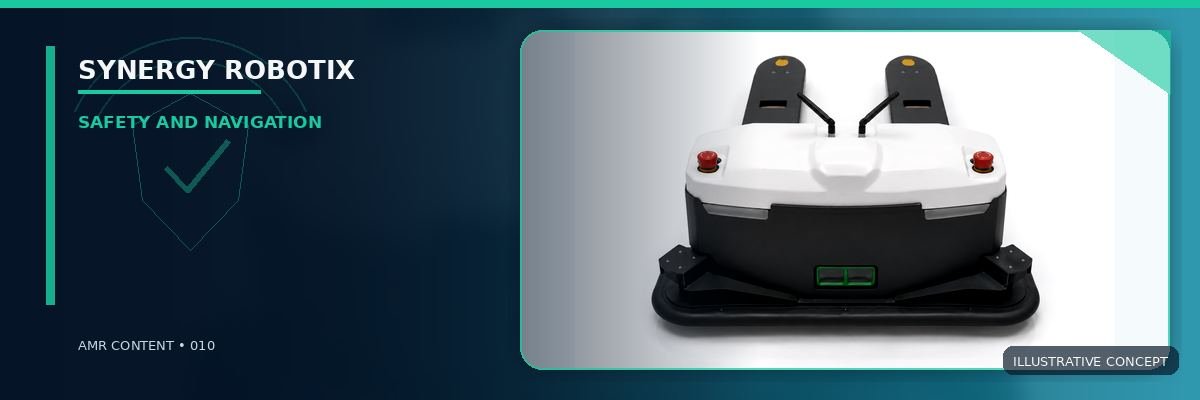
Design the operating concept for AMR Safety and Navigation
Operating concept
Interaction map
Verification evidence
Engineering inputs that shape AMR Safety and Navigation
Evidence to prepare before equipment selection
- Operating modes and authorised roles
- Hazard and interaction map
- Protective functions and site controls
- Maintenance, cleaning and recovery procedures
- Training and emergency arrangements
- Traceable verification and acceptance records
Move from hazard review to controlled operation
For AMR Safety and Navigation, the operating sequence should make task ownership, physical handling, system states and recovery visible from release through completion.
-
Describe the work
-
Identify interactions and hazards
-
Choose layered controls
-
Implement and verify
-
Operate and review
Connect AMR Safety and Navigation to equipment and information flow
Interfaces around AMR Safety and Navigation should be stateful, testable and owned. A clear handshake is easier to operate and support than a collection of one-way commands.
Task and fleet layer
Warehouse or production systems
Fixed equipment
Operator and support tools
Design safe operation and practical recovery for AMR Safety and Navigation
Subjects to include in the installed review
- Operating modes and authorised users
- Shared-space traffic and crossings
- Load and transfer-point hazards
- Protective functions and site controls
- Maintenance and manual recovery
- Emergency stop and controlled restart
Evidence to review before approving AMR Safety and Navigation
For AMR Safety and Navigation, convert assumptions into records that can be reviewed, tested and maintained through the project lifecycle.
| Decision area | Evidence to prepare | How to validate it |
|---|---|---|
| Workflow | Origins, destinations, demand, queues, priority and fallback | Run normal and peak mission patterns |
| Load or payload | Load dimensions, mass, centre of gravity, carrier condition, orientation and transfer method | Use representative carriers and worst credible conditions |
| Route and environment | Manufacturing and industrial facilities, including constraints and shared traffic | Test the least-forgiving sections |
| Interfaces | Wms, wcs, erp or mes tasks, scanners, conveyors, doors, lifts, call stations, production controls and charging points | Challenge acknowledgement, timeout and recovery |
| Operations | Charging, maintenance, training, support and change control | Rehearse intervention and controlled restart |
Measure the operating outcome for AMR Safety and Navigation
For AMR Safety and Navigation, useful performance measures connect mobile activity with the workflow result and the effort needed to sustain it.
Flow reliability
Operational effort
System availability
A staged route from concept to acceptance for AMR Safety and Navigation
-
Discover
-
Survey
-
Engineer
-
Implement
-
Accept
Related robots, applications and guides
Use these Synergy Robotix resources to compare adjacent product, application, integration and selection decisions connected with AMR Safety and Navigation.
FAQ
Questions buyers ask
Straight answers about AMR Safety and Navigation.
Still have a question? Our engineers answer every enquiry personally.
Who should participate in planning AMR Safety and Navigation?
Operations, engineering, safety, controls or IT, maintenance, equipment providers and the people responsible for emergency response and recovery should contribute.
Are vehicle sensors enough to make an application safe?
No. Protective sensing may be combined with speed and route rules, layout, separation, visibility, access, training, procedures and emergency arrangements according to the installed risk assessment.
Which operating modes need review?
Review normal automatic work, supervised operation, maintenance, cleaning, manual movement, blocked routes, emergency response, fault recovery and restart.
How should changes be controlled?
Reassess route, load, carrier, speed, software, traffic, layout and operating-role changes before release. Record approval, testing and training where required.
What evidence should be retained?
Keep the operating concept, hazard assessment, requirements, configuration, test results, training records, maintenance instructions and approved recovery procedures.
Let us engineer the right fit
Plan AMR Safety and Navigation around the real operation
Tell us what you move, where it needs to go and what gets in the way.