[et_pb_row admin_label=”row”]
[et_pb_column type=”4_4″][et_pb_text admin_label=”Text”]
Warehouse automation
Warehouse Transport AMR
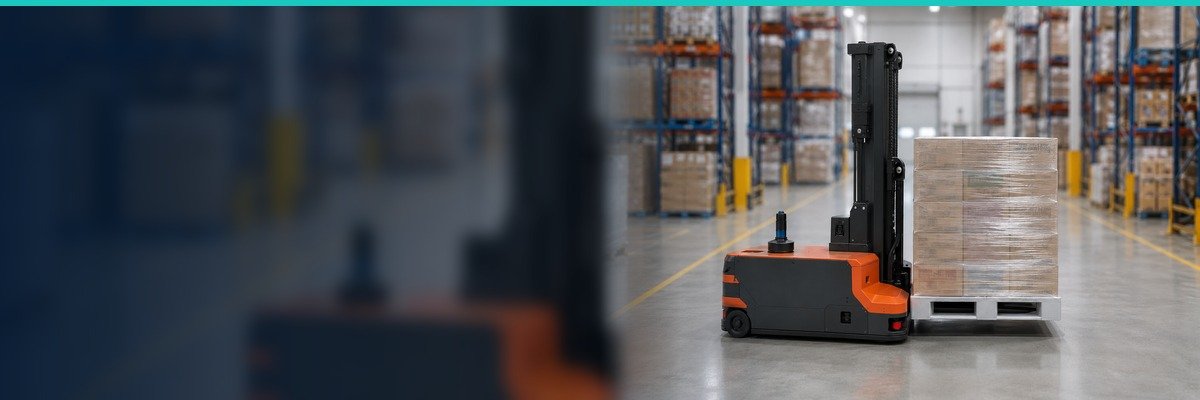
Move pallets, totes, racks, carts and production materials between warehouse zones with an autonomous transport solution engineered around the load, route, transfer points and operating workflow.
Multi-zone movement
WMS and equipment interfaces
Controlled material flow
Turn repetitive transport into a coordinated warehouse process
Warehouse transport AMRs can take over repeatable movement between defined pickup and delivery points while operators remain focused on receiving, picking, checking, packing and exception handling. The strongest applications have a stable load unit, clear handoff rules and enough repeat demand to justify an automated transport layer.
Synergy Robotix plans AMR solutions around the facility layout, process flow, payload, safety needs and required system interfaces. The result should fit the operation that already exists, or the future workflow being designed, rather than forcing the warehouse into a generic robot template.
Receiving and putaway support
Move received pallets, totes or containers from inspection and staging areas toward storage, decanting or replenishment points. Task release can be linked to a scan, operator call, PLC signal or warehouse-system event.
Replenishment and picking support
Deliver stock to pick faces, transfer completed picks to checking or packing, and return empty carriers. Separating transport from picking can reduce unnecessary walking and waiting without changing the core picking method.
Packing, staging and dispatch
Connect packing stations with consolidation, palletisation, marshalling and dispatch lanes. Controlled destinations and positive delivery confirmation help keep physical movement aligned with order status.
Load handling
Choose the transport interface around the load
The robot platform is only one part of the solution. Reliable operation depends on how the load is supported, identified, collected, retained and released at every handoff.
| Load unit | Typical handling approach | Important engineering checks |
|---|---|---|
| Pallets and stillages | Fork entry, low-lift pallet movement, under-pallet carrier or compatible transfer stand | Pallet condition, entry pockets, load centre, underside clearance, stability and required lift |
| Totes, cartons and bins | Shelf, enclosed bay, conveyor top, lift deck or automatic transfer module | Dimensions, containment, transfer height, orientation, accumulation and identification |
| Carts and trolleys | Tugger, drawbar or automatic coupling system | Coupling geometry, train length, corner sweep, castor behaviour and safe decoupling |
| Racks and mobile shelves | Under-rack lift or purpose-designed carrier interface | Rack stiffness, datum points, floor clearance, centre of gravity and workstation protection |
Final payload and lift capability depend on the complete configuration, including load centre, carrier geometry, attachment, route, floor and operating conditions.
Operating sequence
How a warehouse transport AMR completes a move
A dependable workflow defines both normal transport and the exceptions that occur when a load, route or interface is unavailable.
Task request
A warehouse system, PLC, call station or authorised operator creates a movement request with an origin, destination and load identity.
Pickup check
The AMR approaches the pickup point, confirms the station state and performs the defined handoff or load-engagement sequence.
Coordinated travel
Fleet logic assigns the task and manages route access, traffic priorities, blocked paths and interaction with other mobile equipment.
Delivery handshake
The destination confirms readiness before the load is released. Completion status is returned to the controlling system.
Exception recovery
Timeouts, damaged carriers, obstructed stations, low battery and communication loss follow agreed recovery and escalation rules.
Connected warehouse movement
Integration keeps digital tasks and physical loads aligned
The integration design should make task ownership, load identity and equipment state unambiguous from request through completion.
WMS, WCS, ERP and MES
Business and execution systems can release work, prioritise movements, identify loads and receive completion or exception status through an agreed interface.
Conveyors and transfer stations
PLC handshakes coordinate station readiness, load presence, transfer direction, completion, timeout and fault recovery.
Doors, lifts and controlled zones
Access devices need defined request, permission and occupancy states so the AMR does not enter an unavailable or unsafe area.
Fleet and operational visibility
Task status, vehicle condition, queue length, blocked routes and charging state can support supervision and continuous improvement.
Site readiness
Safety is designed around the complete operating environment
Sensors and protective functions on the vehicle are not a substitute for application-level risk assessment. People, manual forklifts, racks, doors, conveyors, loads and recovery activities all form part of the system.
- Map pedestrian routes, crossings, blind corners, shared aisles and vehicle traffic.
- Check floor condition, gradients, drainage, joints, thresholds and operating clearances.
- Define controlled pickup and delivery zones, including access during automatic transfer.
- Set rules for manual mode, maintenance, blocked-load recovery and emergency response.
- Validate representative loads and conditions through documented acceptance tests.
- Train operators, supervisors and maintenance personnel for normal and abnormal operation.
Project delivery
A practical route from workflow study to acceptance
Capture the current flow
Record origins, destinations, load data, movement frequency, peaks, waiting time, staffing, shift pattern and the manual fallback.
Survey and define the concept
Confirm the route, traffic, handoff geometry, charging approach, system boundaries, safety measures and capacity assumptions.
Connect equipment and software
Develop interfaces, permissions, alarms, task states and recovery logic with the warehouse and automation teams.
Test representative operation
Run normal flow, peak flow, route blockage, unavailable stations, low battery, lost communication and restart scenarios.
Handover and improve
Train users, define maintenance responsibilities, monitor operating data and refine task rules as the warehouse evolves.
Explore related solutions
Build the right warehouse automation pathway
Frequently asked questions
Warehouse transport AMR questions
What loads can a warehouse transport AMR move?
Common applications include pallets, stillages, racks, totes, cartons, bins, carts and production materials. The suitable platform and interface depend on load mass, dimensions, centre of gravity, carrier condition, pickup geometry and required transfer method.
Does an AMR need fixed tracks on the warehouse floor?
Many AMRs navigate within a mapped operating area rather than following a physical track. The route still needs engineering for clearances, traffic rules, transfer points, crossings, wireless coverage and safe interaction with people and equipment.
Can a warehouse AMR connect with WMS or ERP software?
Yes, where the selected systems provide suitable interfaces. The project should define which system creates tasks, how loads are identified, how priorities are handled and what completion, timeout and exception messages are exchanged.
How is the required fleet size calculated?
Fleet sizing uses demand by time period, loaded and empty travel, pickup and delivery duration, queueing, charging, traffic interaction, availability and the required service level. The result should be checked against peak and exception scenarios, not only average demand.
Can AMRs share aisles with workers and forklifts?
Shared operation may be possible when the risk assessment, route layout, protective functions, traffic rules, visibility, speeds and recovery procedures support it. Segregation or controlled crossings may still be preferable in higher-risk areas.
What information is needed for an initial assessment?
Prepare a layout, route list, load photographs and dimensions, carrier details, movement frequency, shift pattern, pickup and delivery interfaces, current delays, system landscape, floor conditions and known safety constraints.
Plan warehouse transport around the real workflow
Share the route map, load details, movement demand and interface requirements with Synergy Robotix. The engineering review can identify a suitable AMR approach and the site data needed for the next design stage.
[/et_pb_row]
[/et_pb_section]